Carbon Border Adjustment Mechanism (CBAM)
The EU Carbon Border Adjustment Mechanism (CBAM) is designed to combat carbon leakage and encourage cleaner industrial production in non-EU countries. It has entered its definitive regime from 1 January 2026. It applies to selected goods in iron and steel, aluminium, cement, fertilisers, hydrogen and electricity, and links the carbon cost of imported goods more closely to the EU Emissions Trading System (ETS).
For businesses, CBAM compliance now depends on reliable installation-level emissions data. Operators outside the EU must monitor and calculate the embedded emissions of CBAM goods in accordance with the applicable CBAM methodology. Where actual emissions are used, they must be independently verified by an accredited CBAM verifier; otherwise, applicable default values may be used. Verified information can be made available to authorised CBAM declarants through the CBAM Registry / O3CI, supporting the annual CBAM declaration and certificate obligation.
CBAM 2026 - Current Position
- Definitive regime from 1 January 2026
- 50-tonne threshold for cement, fertilisers, aluminium and iron & steel
- Actual embedded emissions require accredited verification
- First 2026 CBAM declaration due 30 September 2027
- Downstream scope expansion proposed from 2028
The 50-tonne single mass-based threshold applies to cement, fertilisers, aluminium and iron & steel; electricity and hydrogen are outside this exemption. The EU is also progressing an extension of CBAM to downstream steel- and aluminium-intensive products. The Commission proposed 180 additional downstream products, while the Council position covers 200; the final scope remains subject to the EU legislative process.
We help installation operators, producers, exporters and importers turn production and supplier data into the information required for EU or UK CBAM compliance.
For EU CBAM, this may include Monitoring Plan preparation, Specific Embedded Emissions (SEE), relevant precursor data, Specific Embedded Free Allocation (SEFA) / free allocation adjustment, the operator’s emissions report and operator’s summary emissions report, verification readiness and accredited verifier coordination, and CBAM Registry / O3CI support. For UK CBAM, we support embodied-emissions data and CBAM liability assessment.

Installation

Monitoring Plan & Production Data

Embedded Emissions & Relevant Precursors

Operator’s Emissions Report

Verification / Default Values

CBAM Registry
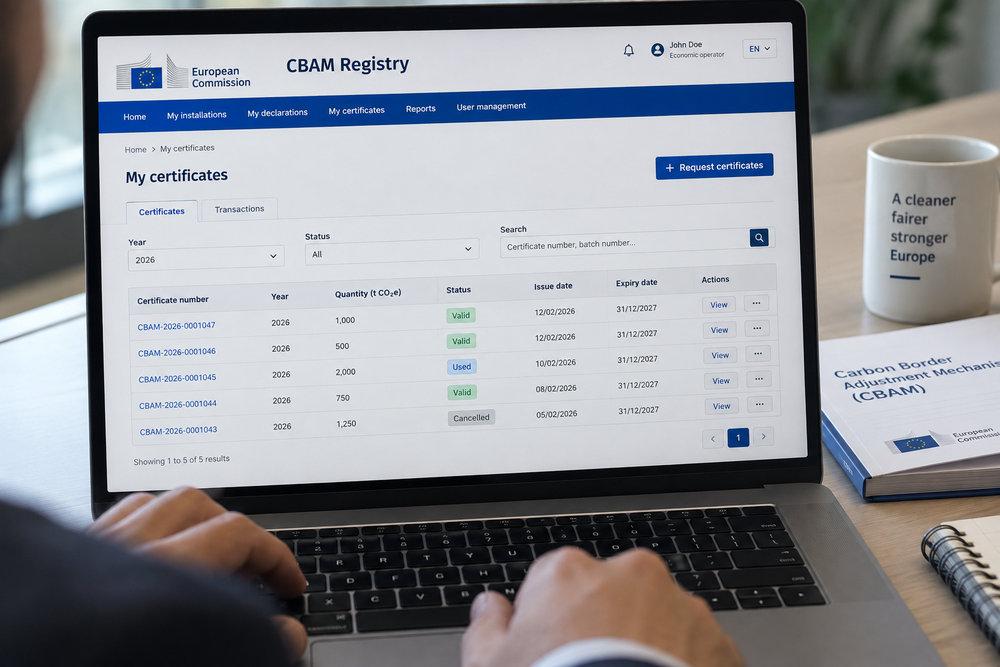
CBAM Declaration & Certificates
Why Us
Human-led, not template-led
Every CBAM engagement is reviewed and prepared by our consultants. We do not rely on generic automated reports or one-size-fits-all outputs.
Our work is built around the client’s actual installation, production process, source data, relevant precursors, monitoring methodology and supporting evidence.
Prepared with verification in mind
CBAM Advisory brings practical experience from carbon project validation and verification. Our consultants apply that experience when preparing Monitoring Plans, emissions calculations, evidence trails and supporting documentation — with independent verification in mind from the outset.
We work backwards from the questions a verifier is likely to ask:
- Where did this data come from?
- How was it measured?
- Which methodology was applied?
- Can the result be traced back to the source records?
- Is there sufficient evidence to support the reported emissions?
That is important because accredited CBAM verifiers review the operator’s monitoring approach, emissions calculations and supporting evidence before issuing the verification report.
Verification-ready, not just report-ready
It is to prepare a clear, traceable and technically supported CBAM file that can withstand independent review.
That means focusing on:
- Monitoring Plan consistency
- data traceability
- measurement systems and source records
- calculation methodology
- relevant precursor information
- data gaps and assumptions
- supporting evidence
- internal controls and documentation
The Commission’s definitive-period methodology specifically treats the Monitoring Plan as the basis for data collection and emissions calculation and requires it to contain the elements needed for verification.
EU CBAM
Monitoring Plan · Embedded Emissions · Relevant Precursors · SEFA · Operator's Emissions Report · Verification · Registry/O3CI
Learn moreUK CBAM
Embodied Emissions · Actual/Default Emissions Data · Relevant Precursor Goods · Carbon Price Evidence · CBAM Liability
Learn moreOur Vision
To make CBAM compliance practical today, while helping businesses reduce the emissions that will drive their future CBAM costs.

CBAM Compliance
Helping businesses meet their CBAM requirements with reliable data, sound calculations and clear reporting.

Lower Emissions. Lower Future CBAM Costs.
Helping businesses understand what is driving their embedded or embodied emissions and where those emissions can realistically be reduced.
Not sure where to start?
Tell us what you produce, where it is produced, where it is exported and what your customer or internal team is asking for. We can help identify the next practical step.